CLICK HERE to view the 2025 Sisco Christmas Letter – 32nd Edition.
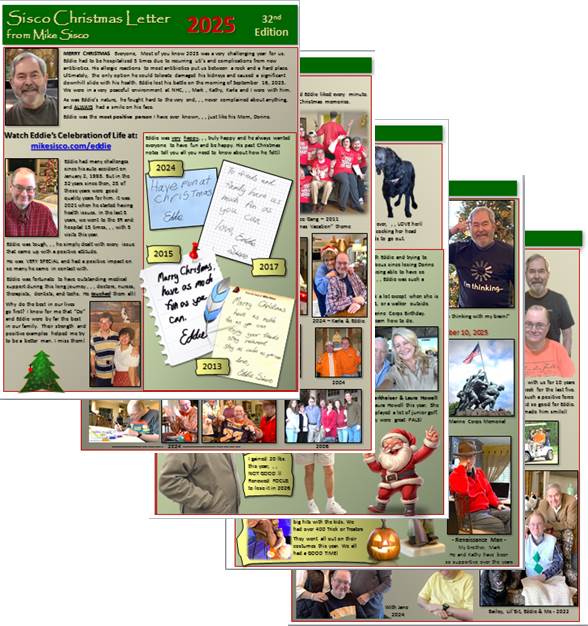
MERRY CHRISTMAS Everyone, , , I hope you have a good one!
Mike Sisco

MERRY CHRISTMAS Everyone, , , I hope you have a good one!
Mike Sisco
 Eddie Sisco, our son, passed away at 4:18am on Tuesday, September 16, 2025. He was 48.
Eddie suffered a traumatic brain injury (TBI) in 1993 that ended his golf career, , , he was an accomplished junior golfer winning many tournaments and several junior club championships.
Eddie had to learn everything all over again. He had many challenges these 32 years after his accident, but he never complained, , , and he met and handled every challenge with strength and grace.
Eddie never met a stranger and everyone who met him liked him because of his big smile and positive personality. When people who have met Eddie think about him, , , I think they smile. Eddie was truly happy and never had a bad day in some difficult circumstances.
Dorine (Mom) passed away in 2020 from COVID, , , we discussed many times how proud we were of Eddie in his accomplishments and more importantly of the person he was growing into. Eddie was simply a delight and fun to be around his entire life.
Learn more about Eddie from the Program Card and videos below created for his Celebration of Life service. CLICK on each image to view content:


Many of my IT Manager Institute classes have been memorable, , , all have been special. The class dinners are especially fun and an opportunity to get to know our IT manager participants better. My wife, Dorine, was able to attend several of the dinners, even two outside the US (Aruba and Slovenia). Dorine was always a hit at a class dinner because she was so comfortable with everyone and a joy for participants to get to know. Plus, she made the dinner more special for me!
OK, to the point of this post, , ,
In my first Slovenia class, we had 18 students, , , it was a great class. Two of the students were 7-feet tall. Giants!

At the class dinner, our “paparazzi” decided to get a unique photo, , , a “bookends” photo of sorts:

I have dozens of unique photos from my Institute classes, , , one-of-a-kind captions that will be remembered forever, , , at least by me. This “bookends” photo just happened to give me a thought for this post.
 Capture what’s going on around you with a photo, , , will be well worth it one day. For example, my sister-in-law works in the athletic department of a large high school. She is always sending me a photo taken with a well known college football coach or celebrity. This one with 7-foot-1-inch Shaquille O’Neal goes well with the theme of this post, , , thanks Kathy.
CLICK HERE to access our 31st edition of the SISCO CHRISTMAS LETTER. Eddie and I hope you have a terrific 2024 holiday season and we wish you a very MERRY CHRISTMAS and a HAPPY NEW YEAR.
I continue creating our annual Christmas Letter primarily to share Eddie’s progress with friends and family. I also know Dorine would want me to continue, , , so I do.
I would be remiss if I didn’t mention that I truly like the creative aspect of creating the letter each year. Hopefully, they are appreciated and meaningful to those who read them.
 Every year since 1994 there has been a Sisco Christmas Letter except for 2021. That year was very painful, both physically with back issues and emotionally. I continued in 2022 and enhanced the 2023 letter by eliminating paper and putting it on my BLOG site. Easier to distribute and provides much more creative possibilities. ALL GOOD!
Dorine’s pot soldier made of five hand painted clay pots sits on our front porch at Christmas time; it is a hit with the kids. At 5-feet tall and bright colors, it’s easy to spot and will put a smile on your face.
Eddie and I hope you enjoy this year’s Sisco Christmas Letter.
We appreciate your LIKE, SHARE, or COMMENT.
Ten years ago I was in Dubai for two weeks. Over the weekend I created a short video for my beautiful wife, Dorine, , , and who was my girlfriend for more than 50 years. I titled it “TWO”, , , it tells our “love story” with background music from the movie, Romeo and Juliet. This song was special for us as it always reminded us of one of our early dates before getting married.
CLICK on the image below to watch the short video.

A good LIST can make all the difference!
 BACKGROUND – On February 12th, I had to call for an ambulance to take Eddie to the hospital, 2nd time this year due to him getting infections that spike a high fever. His temperature can go from normal at 98.6° to 103.5° in an hour when he gets these infections. We went all of 2023 without an incident, , , but were hospitalized 7 times in 2021-2022. Unfortunately, we are not getting off to a good start in 2024.
Eddie suffered a traumatic brain injury in 1993 and has no short term memory as a result. For this reason, I or someone we know is with him 24×7, especially when he is hospitalized because he isn’t able to provide accurate information to the medical staff, , , which creates a danger for himself. This means I have to provide answers to medical questions to keep doctors and nurses on the right path of helping Eddie get well.
 Eddie is highly allergic to many things, especially certain antibiotics. He has had three incidents of Stevens Johnson Syndrome that we know of. It causes burns and blistering inside and outside your body and can even be fatal. Eddie had a serious case of this in 2017 that caused him to be hospitalized and in rehab for 6 weeks after what should have been a 2-day hospital stay from surgery for a broken arm.
For this reason, I’m EXTREMELY CAUTIOUS and WATCHFUL during Eddie’s medical care.
LISTS ARE VERY HELPFUL – I use two tools to help me provide accurate information during Eddie’s hospital and medical visits. Both of these are extremely helpful, albeit very simple and straightforward.
 The first tool is a simple LIST of known allergies which is quite long, and a smaller LIST of the antibiotics we know Eddie’s body can tolerate.
At the beginning of every new nurse or doctor encounter we go over this LIST because giving him medication that’s on his ALLERGY LIST can have serious implications for Eddie. Having the LIST makes this process easy and reassuring that we won’t be giving him dangerous medications. Even so, I check and validate every medication he is given to be sure Eddie isn’t harmed by an accidental dosage of something he is allergic to, , , and that it is the proper dosage.
The second tool is a medical journal of sorts that I keep in a small pocket size leather journal. In it, I document medical activities Eddie encounters, even significant events at home. In the hospital, I write down every medical activity to track what takes place and when it happened. These journal entries become invaluable at times and help me and the medical staff stay on top and in sync with what’s going on with Eddie’s care and treatment.
Even though the nurses chart all of their activities, mistakes happen, , , and we have seen plenty of them in 30 years since Eddie’s accident.
Details are important in treating Eddie’s medical challenges, especially when he has to be hospitalized. Good intentions and prescribing common medicines that work for most people are dangerous for Eddie so my job is to be there with all the information possible and to inspect his treatment to insure it is reasonable for his situation and set of circumstances.
HOW DOES THIS APPLY TO IT MANAGEMENT?
Great question. My point is that when you have routine types of things that happen in your work, it helps to have a LIST that can work toward educating others, provide steps that you need to take or to do something, or simply reminders for you so you can execute and do your work effectively. I use LISTS for all types of things and have since the beginning of my career.
LISTS help you organize and be organized. They help you complete things thoroughly and completely. And LISTS can even reduce stress when you know you have “ticked off” everything needed to get the job done in a particular situation. I recommend using LISTS in any situation where you need to be precise and thorough to complete a project. It will make a positive difference for you.
I always appreciate your LIKE, COMMENT or SHARE of this post.
 P.S., Eddie is doing well and always has a GOOD DAY. He is strong and resilient, , , such a great guy to be around. Everyone who meets Eddie likes him; he has a special gift.
 I’ve hosted many class dinners over the years as part of delivering my IT Manager Institute class. They were always fun, a few were truly memorable, and several were held in very interesting places. I will probably add future Friday FUN posts to tell you about more of these.
Dorine was able to attend several of the class dinners. She always went to class dinners held in the Nashville area, and she was able to travel to Orangestad, Aruba and Ljubljana, Slovenia with me. Both of the dinners she attended at these venues were memorable, , , I’m thankful I always took photos in these class events.
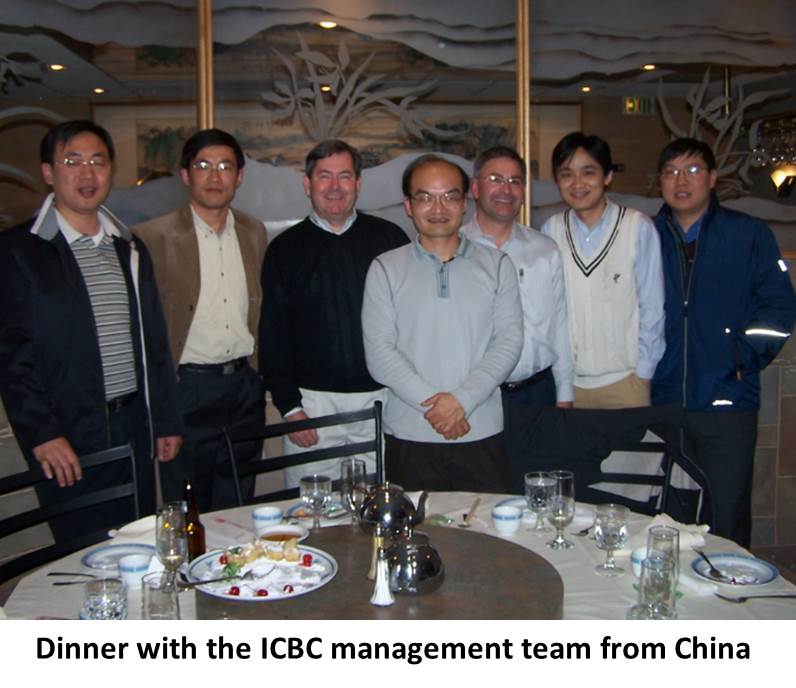
The subject of this post is about the class dinner I held for a special class from China. The largest bank in China (ICBC) sent four of their top IT managers, their CTO and three Directors, to Boulder, Colorado to attend a 3-month IT manager internship program organized by IBM. My 5-day IT Manager Institute was used to kick-off the program. At the time, these managers were responsible for 8,000 IT employees in their huge company.
Prior to the class, I researched Chinese culture to gain knowledge of their customs. I did this for any class I taught made up of students predominately from outside the US. Things that are OK or appropriate in the US are not always viewed that way in some countries.
This class was very interesting in that their IBM Marketing Rep from China also attended and he interpreted some of the things for them. Their English ranged from about 50-70% and my Chinese was and still is 0%. Several funny things happened in this class, but that’s a topic for another time.
Let’s talk about the class dinner.
 The Chinese group had been in Boulder a couple of weeks to get oriented and settled in, and they found a very nice Chinese restaurant in downtown Boulder. It’s where they ate dinner most nights, , , so we went there. The table we sat at was a traditional round Lazy Susan table that allowed you to spin the serving section around to transfer some of each dish to your plate.
One of the things I learned in my research about the Chinese is that when you put food on your plate, , , you need to eat all of it. It’s impolite to leave good food on your plate. I was raised this way myself being from the South.
The chef took care of all the food items. We chose a fish dinner so there were several appetizers along with a full length sea bass plus multiple vegetable dishes and other items to go along with the main course. Two funny things happened, at least they make me smile when I tell the story.
1. One of the appetizers was jellyfish. Remember what I discovered about eating everything you put on your plate? Well, I made the mistake of taking a bit more of the jellyfish than I should have. For me, it was terrible, , , both in taste as well as texture. BAD NEWS, , , but I ate all of what I put on my plate. Lesson learned!!
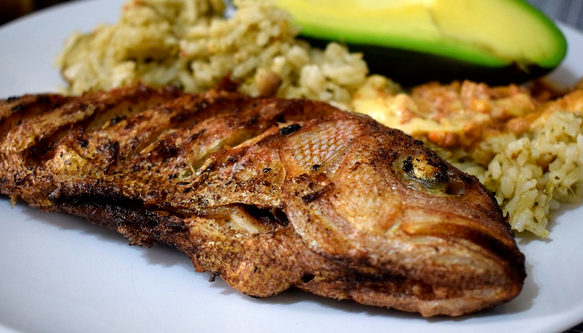 2. The second funny thing was concerning the main course, a full length sea bass. It looked similar to the image to the right, , , 18 to 24 inches of fish from head to tail on a garnished dish. One of the traditions at a Chinese dinner is that you present the main course to the senior person or honoree, and he or she takes the first part of the dish. In this case it was the CTO, Mr. Lu.
The table was turned to display the fish to Mr. Lu. He proceeds to carve the head off of this big fish and puts it onto his plate. I thought he was simply prepping the fish for the rest of us, but that wasn’t it at all. I looked over a few minutes later and everything was gone except for a small pile of bones, , , he ate the head, eyes and all. I was told the head is actually considered the delicacy part of the fish.
Later, during our conversations I mentioned to the local IBM manager who coordinated the internship event for the ICBC manager team, “Tom, when you visit the group in China, you will be the honoree at dinner.” Tom laughed and quickly replied, “Well, we won’t be having fish.”
By the way, the dinner was completely authentic and delicious, , , except for the jellyfish. Good food, good company and a great night.
Hope you like this one. I appreciate your LIKE, COMMENT, and SHARE of this post.
CLICK HERE to learn more about the IT Business Manager (ITBMC) program.

 I’ve always used images, scenarios, and anecdotes to drive home a point. These techniques help me and the people I manage focus on the issue at hand. In this post, I want to talk about “how to focus”, a key for success in any organization.
I’ll give you two examples where FOCUS helps your team succeed. These examples are outside of IT and they are in completely different situations, but they are relevant when it comes to managing an IT organization. The BOTTOM LINE – FOCUS LEADS TO SUCCESS.
Example 1 – Lines of Fire
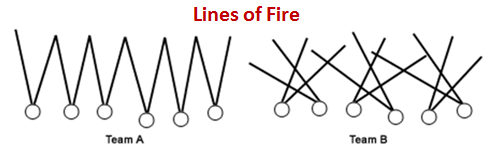
This image represents two examples of the “lines of fire” that can be used by a small Marine Corps “fire team.” One of them has a much higher rate of success than the other. Which one gives the best coverage? How does this relate to technology? Hang on; we will get there.
Fire Team A looks very organized and appears to cover all areas of the field in front of the team. The diagram for Team B looks very chaotic and disorganized. The fact is that the fields of fire laid out for Team B will cover the area much more effectively than Team A’s plan because the lines of fire overlap, a technique that is particularly important when one Marine is reloading his weapon.
As you can see, each Marine is responsible for a specific line of fire. If a Marine deviates from his responsible area, the full capacity of the team begins to weaken. The same is true with an IT organization. Every team organization is dependent upon its team members. Marines stay focused because they learn to obey orders and are trained over and over again for the scenarios they will encounter. Keeping your IT team focused requires different skills, but the theory is the same.
As a CIO, I picked up a new IT organization many years ago through an acquisition by our company. My assessment indicated that senior managers and the operations groups of the company had very little confidence in the IT organization. The IT staff’s impression was that they were overworked, had no support, and lacked the staff and money to do the job properly. This wasn’t exactly the case as I saw it.
There was plenty of staff members but a lack of focus and organization. Everyone was trying to do everything. No one could identify his or her own responsibility. Yes, they were working hard but not working productively, , , or even smart. Because of the lack of focus, the organization was spending money in many of the wrong places. Slowing the treadmill and assigning specific “lines of fire” (responsibilities) to each employee made all the difference because everyone’s role was clearly defined, and they became more focused. And guess what, their results improved significantly.
For example, we broke down the programming responsibilities. Some people supported existing applications, a different group developed application enhancements, and another team focused only on hospital interfaces, a key initiative for the Operations Division’s needs.
We created change management procedures and introduced quality assurance processes that were previously nonexistent. Initially, there was a strong feeling by the senior people in IT that this strategy would just delay the delivery of software changes for our clients. After two months, they could see that the plan actually improved productivity because the time spent reworking and scrambling to catch up was reduced. It also reduced duplication and improved user acceptance.
Focus made all the difference.
Let’s look at another example, , ,
Example 2 – Football Offensive Line Assignments

Another way to look at the situation is with the image to the right. Think of your IT team as you would the offense of an American football team. In the offensive component of football, you have many different types of responsibilities, such as blocking, receiving a pass, and carrying the ball, , , all of which are led by the actions of the quarterback (blue dot). You have similar organization in your IT team. You have software developers, business analysts, help desk resources, network administrators, etc. all led by a manager.
In football, you design plays to handle your opposition and push the ball down the field. In this example, the defensive players represented by the triangles have one objective—to stop the offensive team cold. You can think of the defense by thinking of client needs and issues as the defensive team. Look at the business applications support requirements of an organization, and you will find that your clients have many different needs, from day to day support, software enhancements, customized programming services, installation services, training, documentation, etc.
The team scenario in the graphic shows that Offensive Players 1 and 2 focus on one need of the offense, , , to block just one player because that defender is so strong. On the other hand, Player 5 has to try to handle two defensive players. The point is that each player has an assigned responsibility and is expected to take care of his assignment. The same need exists in your IT department.
Change the defensive player names to application enhancements, daily support needs, new installations, education needs, etc. and you begin seeing the need to focus each of your IT employees on specific areas of responsibility. You run the risk of duplicated and wasted effort if your IT team is not organized to take care of a specific set of responsibilities. Some key assignments may simply be missed if the members of your IT team are not focused to play their part in delivering the overall IT support needed by your client.
SUMMARY – Take the time to organize and establish specific responsibilities for your IT staff. You will achieve big benefits in doing so. Once you have everyone’s responsibilities quantified, empower and motivate your employees to take care of their business responsibility in a manner that supports the team by focusing on their key assignments. If you have laid out your “lines of fire,” you will win the battle and have a lot more fun.
I appreciate your LIKE, COMMENT, or SHARE of this post.
 We all have “small world stories” – right? I’m sure you have a few just like I have many that I could share, , , but the one that stands out like no other is the one you are about to read about.
BACKGROUND – First, you need to meet a couple of people.

OK, I met Paul Cooper in March of 2013, then again at my home in 2016 when I met with Paul and one of his colleagues to discuss some work issues. I got to know Paul pretty well over time.
FAST FORWARD A COUPLE OF YEARS, , ,
It’s a Tuesday and I get a call from Uncle Bobby. He has a new TV and he is trying to record something but can’t seem to make it work. I tried to troubleshoot the issue over the phone but we weren’t getting anywhere. Bobby was in his late 80’s at the time and I’m not the best tech support guy, , , so I said, “Uncle Bob, I’ll drive over to Hohenwald and look at it, and we can go to lunch while I’m there.” He said it could wait, but it was a good excuse for me to visit him so I drove to Hohenwald.
Turned out that he didn’t actually have the cable service that allowed him to record programs on his TV so I couldn’t fix the issue. We decided to go to lunch and opted for The Junkyard Dog restaurant since it was going to be a short visit. One problem, , , the restaurant is closed, , , unusual but closed nonetheless.
We talked about our options and decided to try Hank’s Cafe. This was a place that had been open for about a year but neither of us had been there before, , , so we drive around the block to go into Hank’s Cafe.
This was a very small cafe, , , tables and a small bar that would seat 25 to 30 people max. It was early so the cafe was empty except for a couple of guys sitting at the bar. Bobby and I take a table and look at the menu and we start talking about a few things.
Then, it happened, , ,
One of the gentlemen sitting at the bar walked over and said in a distinct Australian accent, “Mike Sisco, what are you doing here?”
And I said, “Paul Cooper, what are you doing here? I grew up in Hohenwald and I’m here visiting my Uncle Bobby, , , Bobby, meet Paul Cooper from Australia!”
I had not noticed that sitting at the bar when we came in was Paul Cooper and his brother from Adelaide, Australia. They were visiting Nashville to attend a music festival and decided to take a bicycle trip down the Natchez Trace for a couple of days. The Natchez Trace is a federal highway that restricts commercial vehicles and is a very scenic ride, , , there are always cyclists riding along the Trace. They were some 40 miles south of Nashville and decided to go into Hohenwald (another 7 miles) to get something to eat and look around.
The odds of us bumping into one another has got to be 100 million to one, I think, , , for these reasons:
I’ve had many small world events in my life, but this is without question the BIGGEST SMALL WORLD STORY in my lifetime. Hope you like it.
Send me a COMMENT and tell me your best “small world story”.
As always, I appreciate your LIKE, COMMENT, or SHARE of this post.
 UGH! What a terrible thought, , , “bite the head of a frog“.
 DISGUSTING, don’t you think?
Well, actually it is a great management topic that I first learned about in 2002, over 20 years ago. Paul Squillante, one of my IBM instructors in the early days of my career and one of the all-time great characters I’ve gotten to know told me about, “Bite The Head Of A Frog”.
BACKGROUND: Paul had joined an Atlanta company I worked with so we became good friends. Two years after I left the corporate world “to do my own thing”, Paul and I decided to have lunch to catch up with one another. At the time, I was developing content for my 12th book – IT Management Models. I kept a journal dedicated to collect material for the new book, and I decided to show it to Paul.
 I’ll never forget what he said after looking through the journal, “If you are going to do this, you have to include, “Bite The Head Of A Frog“.
I was dumbfounded, , , had no idea what he was talking about, , , so he began to explain. Long story short, I included this model in the new book and have shared it with thousands of IT managers around the world. Very few, if any, were familiar with this concept.
BITE THE HEAD OF A FROG: This management principle is all about breaking through procrastination. It is human nature that when we have something distasteful to do, , , we tend to put it off and deal with it later, , , we procrastinate. It could be anything like:
The point is that we put things off that we aren’t truly motivated to do. What “Bite The Head Of A Frog” says is to take care of the distasteful issue proactively:
This eliminates lots of stress and worry because the issue doesn’t go away, , , it nags at you in the back of your brain (or in your tooth) until you finally take care of it. You will find that when you address issues more proactively you use up less energy and helps you be more positive about your day.
CLICK HERE to learn more about Bite The Head Of A Frog:

I appreciate your LIKE, SHARE, or COMMENT.
 Mike Sisco, ITBMC