
 I’ve always used images, scenarios, and anecdotes to drive home a point. These techniques help me and the people I manage focus on the issue at hand. In this post, I want to talk about “how to focus”, a key for success in any organization.
I’ll give you two examples where FOCUS helps your team succeed. These examples are outside of IT and they are in completely different situations, but they are relevant when it comes to managing an IT organization. The BOTTOM LINE – FOCUS LEADS TO SUCCESS.
Example 1 – Lines of Fire
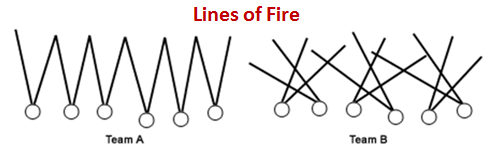
This image represents two examples of the “lines of fire” that can be used by a small Marine Corps “fire team.” One of them has a much higher rate of success than the other. Which one gives the best coverage? How does this relate to technology? Hang on; we will get there.
Fire Team A looks very organized and appears to cover all areas of the field in front of the team. The diagram for Team B looks very chaotic and disorganized. The fact is that the fields of fire laid out for Team B will cover the area much more effectively than Team A’s plan because the lines of fire overlap, a technique that is particularly important when one Marine is reloading his weapon.
As you can see, each Marine is responsible for a specific line of fire. If a Marine deviates from his responsible area, the full capacity of the team begins to weaken. The same is true with an IT organization. Every team organization is dependent upon its team members. Marines stay focused because they learn to obey orders and are trained over and over again for the scenarios they will encounter. Keeping your IT team focused requires different skills, but the theory is the same.
As a CIO, I picked up a new IT organization many years ago through an acquisition by our company. My assessment indicated that senior managers and the operations groups of the company had very little confidence in the IT organization. The IT staff’s impression was that they were overworked, had no support, and lacked the staff and money to do the job properly. This wasn’t exactly the case as I saw it.
There was plenty of staff members but a lack of focus and organization. Everyone was trying to do everything. No one could identify his or her own responsibility. Yes, they were working hard but not working productively, , , or even smart. Because of the lack of focus, the organization was spending money in many of the wrong places. Slowing the treadmill and assigning specific “lines of fire” (responsibilities) to each employee made all the difference because everyone’s role was clearly defined, and they became more focused. And guess what, their results improved significantly.
For example, we broke down the programming responsibilities. Some people supported existing applications, a different group developed application enhancements, and another team focused only on hospital interfaces, a key initiative for the Operations Division’s needs.
We created change management procedures and introduced quality assurance processes that were previously nonexistent. Initially, there was a strong feeling by the senior people in IT that this strategy would just delay the delivery of software changes for our clients. After two months, they could see that the plan actually improved productivity because the time spent reworking and scrambling to catch up was reduced. It also reduced duplication and improved user acceptance.
Focus made all the difference.
Let’s look at another example, , ,
Example 2 – Football Offensive Line Assignments

Another way to look at the situation is with the image to the right. Think of your IT team as you would the offense of an American football team. In the offensive component of football, you have many different types of responsibilities, such as blocking, receiving a pass, and carrying the ball, , , all of which are led by the actions of the quarterback (blue dot). You have similar organization in your IT team. You have software developers, business analysts, help desk resources, network administrators, etc. all led by a manager.
In football, you design plays to handle your opposition and push the ball down the field. In this example, the defensive players represented by the triangles have one objective—to stop the offensive team cold. You can think of the defense by thinking of client needs and issues as the defensive team. Look at the business applications support requirements of an organization, and you will find that your clients have many different needs, from day to day support, software enhancements, customized programming services, installation services, training, documentation, etc.
The team scenario in the graphic shows that Offensive Players 1 and 2 focus on one need of the offense, , , to block just one player because that defender is so strong. On the other hand, Player 5 has to try to handle two defensive players. The point is that each player has an assigned responsibility and is expected to take care of his assignment. The same need exists in your IT department.
Change the defensive player names to application enhancements, daily support needs, new installations, education needs, etc. and you begin seeing the need to focus each of your IT employees on specific areas of responsibility. You run the risk of duplicated and wasted effort if your IT team is not organized to take care of a specific set of responsibilities. Some key assignments may simply be missed if the members of your IT team are not focused to play their part in delivering the overall IT support needed by your client.
SUMMARY – Take the time to organize and establish specific responsibilities for your IT staff. You will achieve big benefits in doing so. Once you have everyone’s responsibilities quantified, empower and motivate your employees to take care of their business responsibility in a manner that supports the team by focusing on their key assignments. If you have laid out your “lines of fire,” you will win the battle and have a lot more fun.
I appreciate your LIKE, COMMENT, or SHARE of this post.




 Capture what’s going on around you with a photo, , , will be well worth it one day. For example, my sister-in-law works in the athletic department of a large high school. She is always sending me a photo taken with a well known college football coach or celebrity. This one with 7-foot-1-inch Shaquille O’Neal goes well with the theme of this post, , , thanks Kathy.
 UGH!
UGH! 

 Managing an IT Organization is hard work to be sure, especially to do it effectively. But, you might be surprised that the formula for IT success is actually pretty simple when you get right down to it.
 Is managing remote employees a new situation for you? Or maybe, you are discovering it to be a challenge.
 Mike Sisco, ITBMC